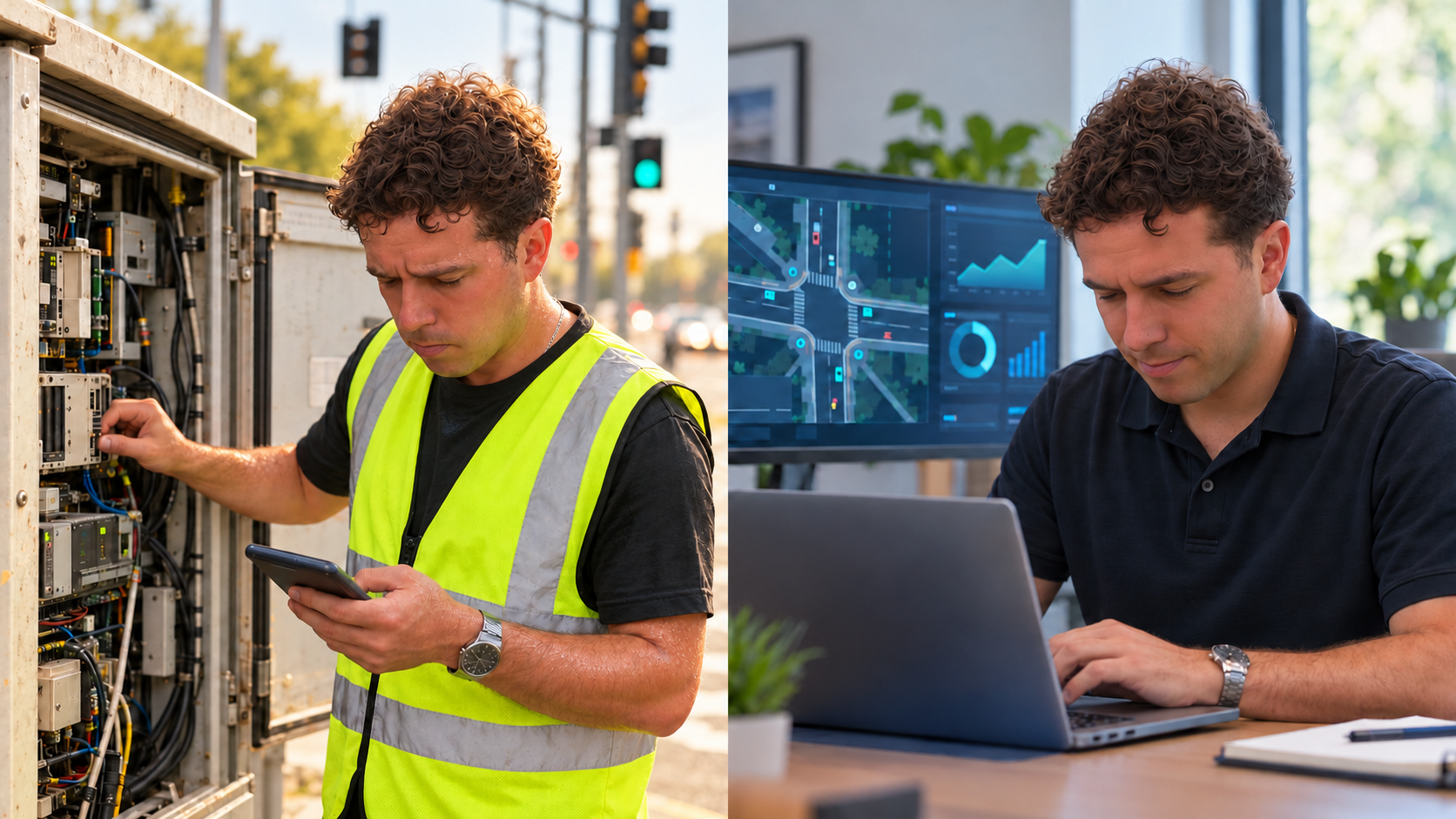
A resident calls in a short side-street green on a Tuesday afternoon. The fix takes two minutes at the panel, but the cabinet sits 10 miles across town and the next available technician is finishing a knockdown on the other side of the network. By the time someone opens the cabinet door, the complaint is a day old and the queue has been backing up through two peaks.
The hidden cost of a cabinet you can’t reach
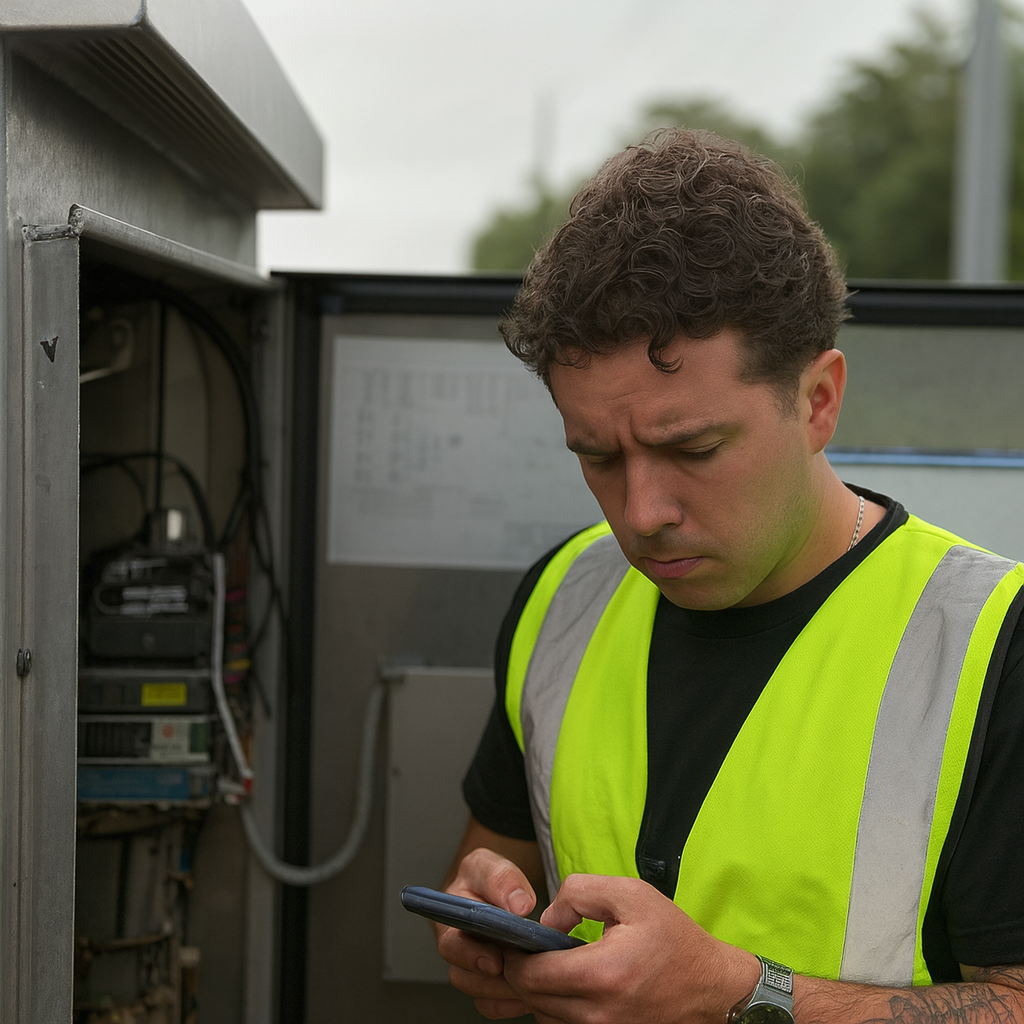
The front panel is how a technician talks to a traffic signal controller (TSC). It’s how they check phase status, read detector calls, confirm coordination and make small timing edits. At an unconnected cabinet, every one of those tasks requires a truck roll.
The U.S. runs roughly 327,860 signalized intersections, and agencies spend about $1.23 billion a year to operate and maintain them (ITE/NOCoE Traffic Signal Benchmarking Report). Staffing is tight across that inventory. The National Traffic Signal Report Card recommends 30 to 40 signals per technician, but agencies surveyed by FHWA averaged 51 (per FHWA).
When each technician covers more intersections than recommended, every routine check competes with emergency repairs. A timing tweak that takes two minutes at the panel can wait days for an open slot. Meanwhile, a poorly timed approach keeps generating delay, red-light running risk and resident complaints. The issue is rarely technical skill. It’s how many hours technicians spend driving between cabinets.
How remote front panel access works
Most modern controllers already serve their front panel through a built-in web interface. Plug a laptop into the cabinet’s Ethernet port and you see the same menus, keypad, channel outputs and detector inputs you’d see on the physical panel. Remote front panel access delivers that same interface over a secure cellular link, so a technician can open it from the office.
Think of it as moving the cabinet door to the technician’s desk. The controller doesn’t change, the timing database doesn’t change, and the technician uses the same screens they already know. What changes is the commute.
The connection is what makes this work for cabinets with no fiber or copper interconnect. A cellular (LTE) modem at the intersection creates an encrypted tunnel to a cloud service. Authorized users sign in through a browser, and the session passes through to the controller’s own interface. Nothing on the controller is exposed directly to the public internet.
Putting it to work at the intersection
NoTraffic’s Front Panel Access brings this capability to agencies through the Mobility OS cloud. It runs over LTE, so it reaches cabinets that have never had interconnect. Technicians open the controller’s front panel in a browser over a secure, end-to-end double-encrypted connection. It works with any signal controller that has a browser user interface, so agencies keep the controllers and timing plans they already maintain.
In practice, that means three things for the signal shop: remote visibility into controller status and timing, fewer trips to the cabinet, and faster resolution of field issues. Agencies activate it from the Mobility Store as part of the AI Mobility Platform, alongside AI detection and 24/7 operations center support.
Next step
If truck rolls are eating into your team’s capacity, book a demo with a NoTraffic expert to see remote front panel access in action.
Sources
- Traffic Signal Benchmarking and State of the Practice Report, ITE/NOCoE: 327,860 U.S. signals and about $1.23 billion in annual O&M spending
- National Traffic Signal Report Card: Technical Report 2007, NOCoE: recommended 30 to 40 signals per technician
- Traffic Signal Operations and Maintenance Staffing Guidelines, Chapter 2, FHWA-HOP-09-006: surveyed average of 51 signals per technician, and the Report Card recommendation (Table 2.2)