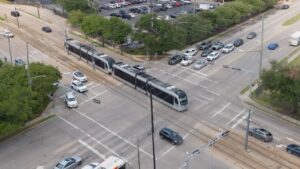


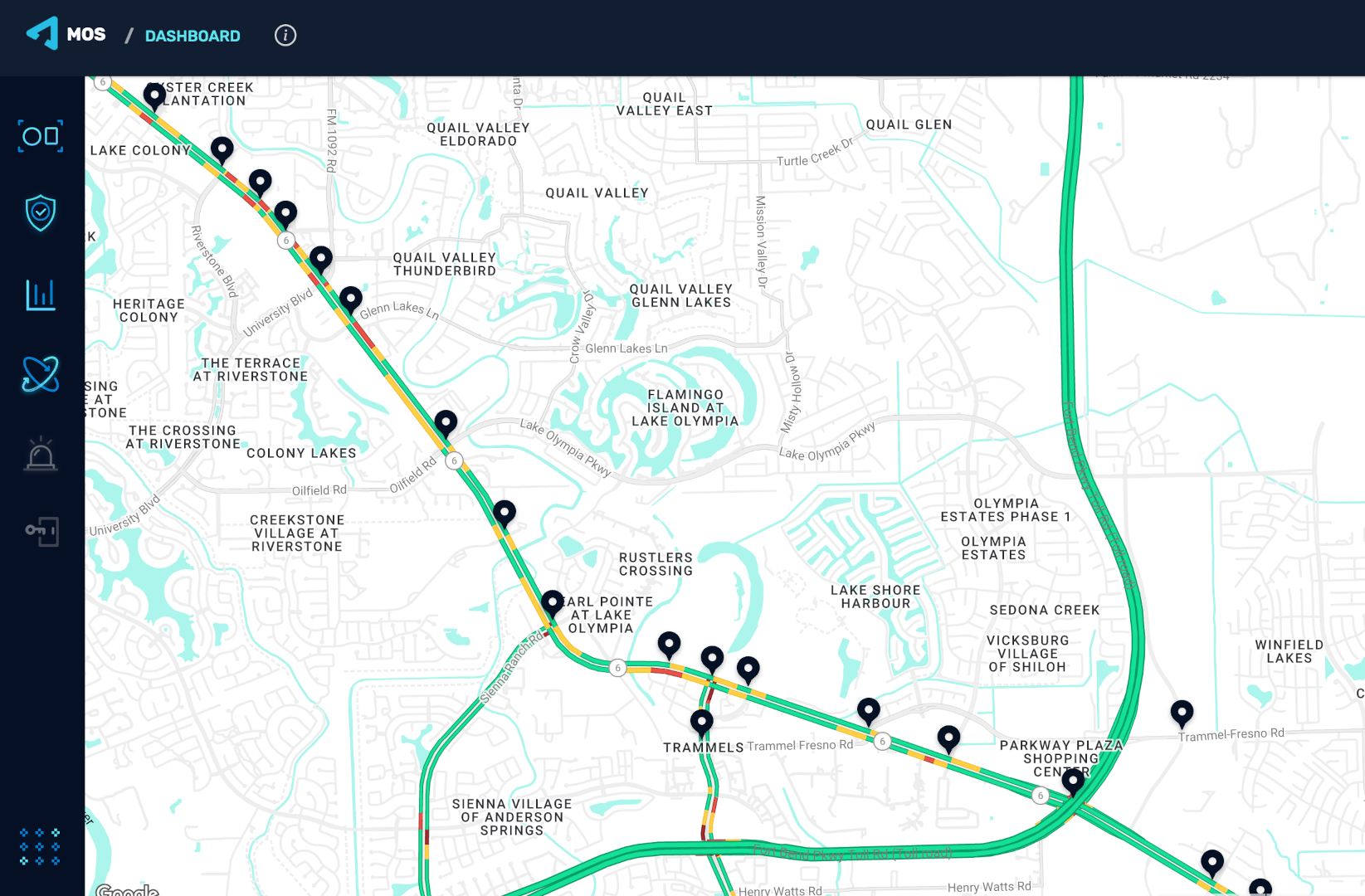
Missouri City deployed NoTraffic’s AI-powered traffic optimization platform across sixteen intersections on State Highway 6, from Watts to Township. The goal: protect corridor performance against rising demand without altering signal sequences, lane geometry, or pedestrian settings.
Beyond the sensor-based before/after analysis, Missouri City’s Engineering, Traffic Operations, and Utilities divisions ran their own independent field validation: three cross-functional teams conducting floating-car travel time studies on paired Tuesdays one week apart, during matched AM and PM peak periods, tracking travel time, complete stops, and signal delay firsthand.
The Result
Within weeks of activation, the sixteen-intersection corridor delivered a network-wide delay reduction even as traffic volume grew 15% year over year. Average overall delay fell 10.3%, and both AM and PM peak delay improved. Coordinated mainline delay — what drivers actually feel moving through SH 6’s core through-movements — improved 6.6% in the morning and 7.9% in the evening.
Safety improved as with a reduction in red-light running of 45%. Overall, the corridor is projected to generate an estimated $52.3 million in economic value in terms of time and gas saved over its five-year service term.
These sensor-based findings were independently confirmed by the City’s own field study: 311 seconds (~30%) — a floating-car study clocked this drop in AM westbound travel time (Alvin/Manvel toward Sugar Land) on a corridor that normally takes 17–18 minutes. This city-run field measurement of travel time independently corroborated the sensor-based results.
● Project Cost: $619,500
● OPT Service Activation Date: March 3, 2026
● OPT Service Duration: 5 years from the date of turn-on
● OPT Service Expiration Date: March 3, 2031
| Metric | Improvement |
| Overall Delay | Reduced 10 % |
| Change in volume | Increased 15% |
| Red-Light Running | Reduced 45.2% |
| AM Peak Delay | Reduced 5 % |
| PM Peak Delay | Reduced 6 % |
| Drive Time Study (Agency) | Up to 30% reduction (311 sec) |
| Total Economic Value * | $ 52.3 M USD |
| CO₂ Reduction ** | Over 19,200 mt |
Optimization Delivers Delay Cuts Even as Traffic Grows
Missouri City’s highway 6 corridor shows what NoTraffic Optimization can do for an agency facing rising traffic and a fixed footprint. By improving the efficiency of existing infrastructure, highway 6 is now able to handle an increase in volume of 15% and still demonstrate a 10% reduction in overall delay.
In addition, highway 6 reduced red-light running nearly in half without new enforcement cameras or geometric changes. And it can do this at real corridor scale: sixteen signals, three major-major conflict points, split-phased side streets, and protected left turns, where trade-offs are real but manageable rather than corridor-breaking.
Excerpt from report:
Missouri City’s independent evaluation of the NoTraffic AI system demonstrates how a municipality can combine sound engineering practices with data-driven decision-making to verify the effectiveness of emerging transportation technologies. By independently confirming measurable reductions in travel time, signal delay, and vehicle stops, the City validated the benefits of AI-based adaptive signal control while reinforcing the importance of accountability in public infrastructure investments.
— Vincenzo S. Corazza, P.E., PTOE, City Engineer, City of Missouri City
For signal teams managing a saturated arterial with no budget for widening, this is a repeatable path: measure what’s actually happening on the mainline, let the system prioritize per-vehicle service quality over any single ratio, and expect a small number of locations to absorb the corridor’s hardest trade-offs so the rest of the network keeps moving.
NOTES:
* Total Economic Value shown in USD and CAD represents time and gas savings over the initial 5-year warranty plus operational savings related to signal re-timing, included data and analytics package, persistent camera installation, and NOC support
** Over initial 5-year warranty period