Traffic detection needs to work all the time—in harsh weather, wind, snow, fog, night, and glare—not just when conditions are ideal.
And any traffic detection program also needs a support infrastructure so it stays up, stays calibrated, and stays trusted by signal operations.
Wavelengths 101: choosing what to see
What’s the “best” traffic detection technology? As with most technical questions, the honest answer is: it depends. Different detection technologies have different ways of “seeing” traffic, and each one comes with its own set of challenges. There are elements that can be adjusted but at the end of the day, “you can’t change physics.”
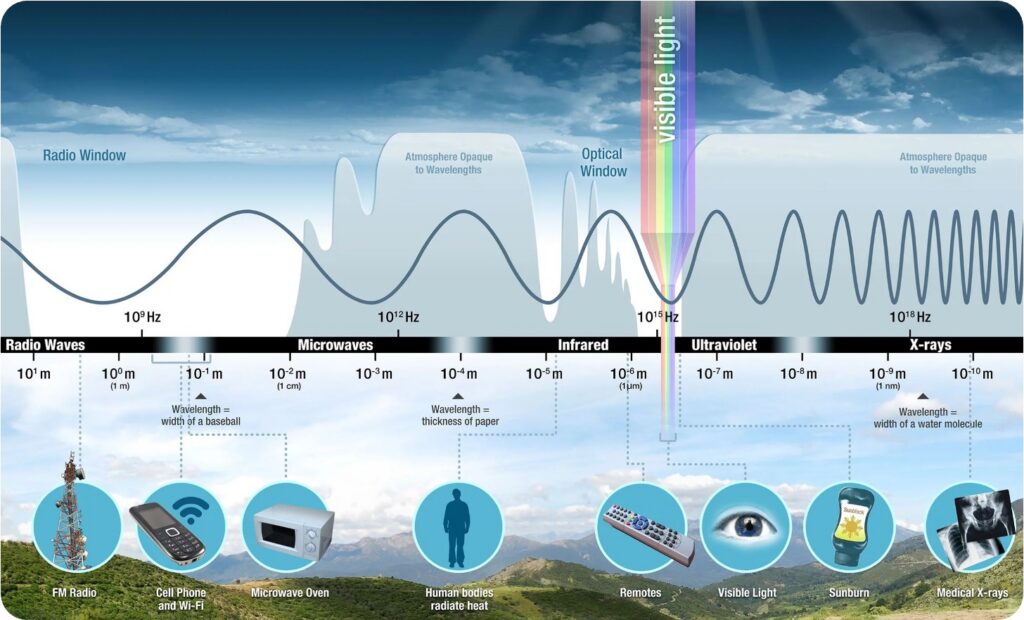
Wavelength is a big reason these sensors behave so differently when conditions change.
- Cameras sense visible light passively – allowing sensing energy to come from the environment.
- LiDAR emits near-infrared light actively (like a flashlight or spotlight – but with a much narrower beam) and measures the returns.
- Radar emits longer-wavelength microwave energy actively and measures the return.
The LiDAR flashlight
Using LiDAR is like using a flashlight. You emit light from a source, it bounces off objects, and you sense the scene by measuring the returned signal. Because it’s light-out / light-in using the near IR band, many of the same limitations that make a flashlight struggle (fog, heavy rain, snow, spray, dust) also impact LiDAR.
LiDAR uses near-infrared light rather than visible light, but the wavelengths are still close enough that fog, rain, snow, spray, and dust can scatter the signal and reduce performance.
The Radar difference
Radar also emits energy, but it behaves differently because its wavelength is much longer – in the microwave band. In practice, that often means that it keeps detecting even when visual or near IR-based sensing degrades.
Radar isn’t a silver bullet (no visual context of the intersection, no classification), but tends to ‘punch’ through inclement weather and detect road users when visibility declines which is critical for traffic operations.
In addition, Radar offers an accurate means of vehicle speed detection necessary for applications, like dilemma zone, that rely on speed.
Comparing nanometers to millimeters in traffic detection
Each technology has benefits and challenges. Here’s a chart of the intersection detection implications (including fusion):
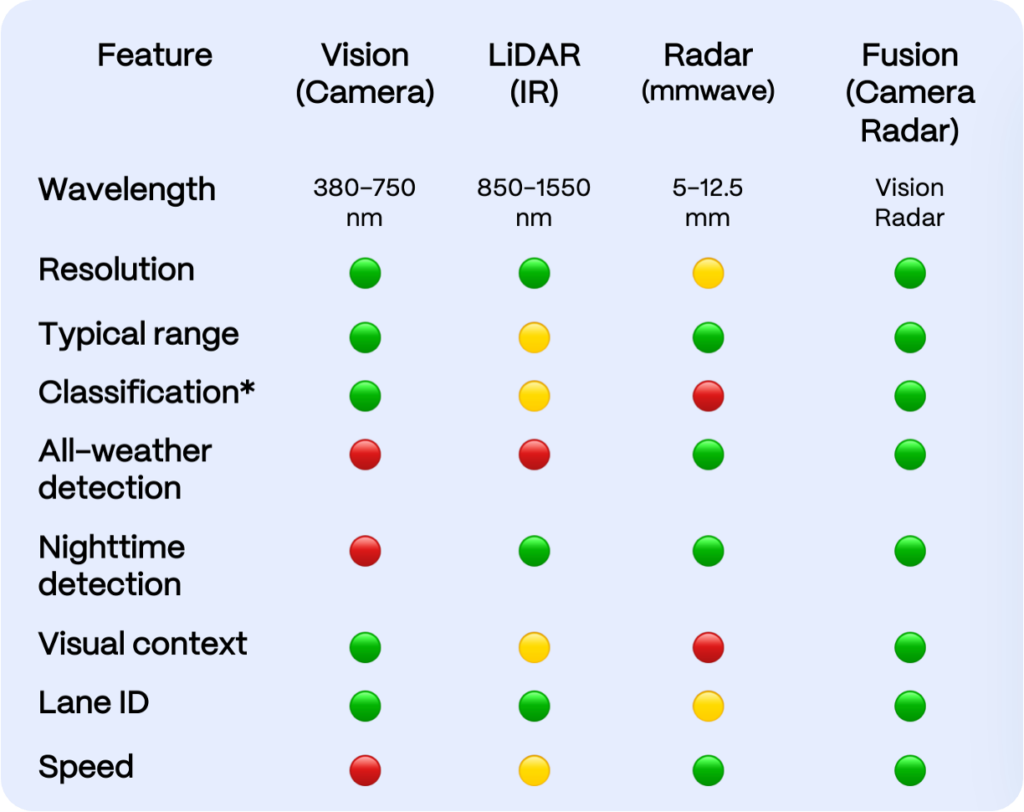
Legend: 🟢 best for that feature · 🟡 situational · 🔴 lowest relative
Notes
* LiDAR classification depends heavily on visibility and surface return quality. LiDAR infers speed indirectly through frame-to-frame tracking
*Radar measures velocity directly via Doppler shift which provides high accuracy for velocity and direction of motion and is resistant to the effects of partial occlusion.
Why Fusion sensors pull ahead
If you run signals, you already know the cost of single points of failure: missed calls, false calls, field visits, and headaches. That’s why leading agencies are moving toward redundancy. Not because any one sensor “wins,” but because redundancy keeps your network running.
You can see in the chart above why fusion is so powerful. Where vision has challenges (weather and speed), radar excels. The opposite is also true. By combining complementary detection technologies and wavelengths traffic engineers get a more comprehensive detection solution.
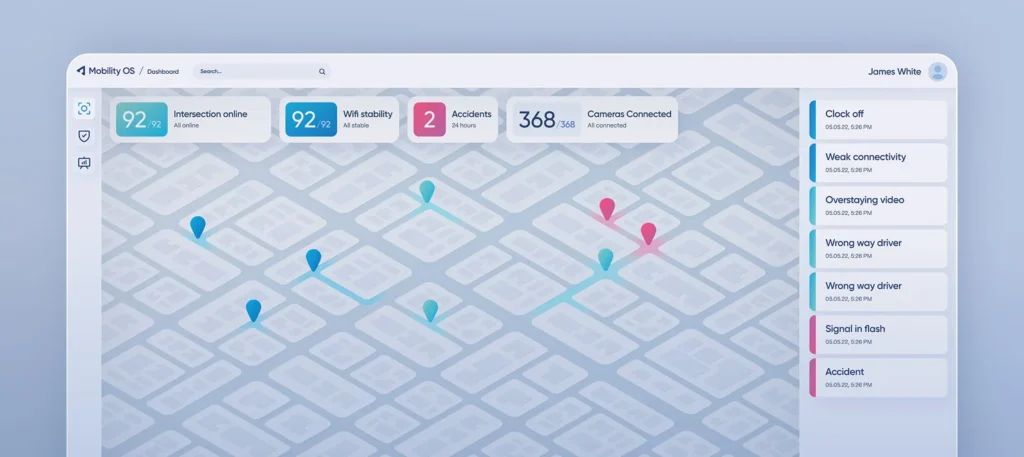
NoTraffic Fusion also provides the georeferencing data to project traffic in multiple dimensions. For example, agencies have a camera level view but also a top down, satellite view of traffic. This trajectory data is continually stored and helps to feed NoTraffic analytics and ATSPM applications on Mobility OS.
Traffic detection is only the start
Even strong sensing can fail if security, service, and accountability aren’t built in. When you evaluate vendors, don’t stop at “does it detect?” Consider how reliable the entire solution is including items like service and support.
- Can they provide verified detection accuracy reports?
- What geographical areas has the technology been deployed? (see our case studies)
- Do they offer staffed 24/7/365 proactive support including live monitoring, over-the-air updates, and a 5-year warranty? (learn about our support)
- Are communications protected by modern security protocols like SOC 2 Type II, TxRAMP, and ISO 27001?
That’s the difference between testing a technology and deploying a solution that an agency can rely on citywide.
The bottom line: use the right detection technology(ies) for the job
So which technology is right for your intersections? If you are running a short study in good weather, many choices work. But when agencies need 24/7/365, all-weather performance for traffic signal detection, plus the security, service, and validation of a full suite traffic management solution, they are turning to NoTraffic’s fusion technology.